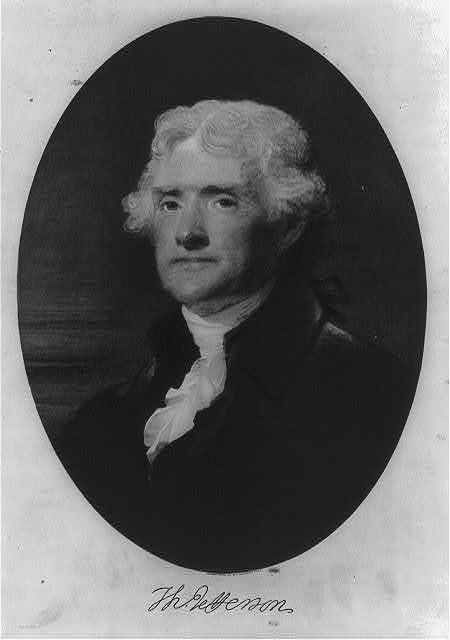
Six primary documents from twenty-five years of public service, 1784 to 1809. Jefferson in Paris watching the French Revolution begin. Jefferson inventing a cipher because European postmasters were opening his mail. Jefferson arguing the earth belongs to the living. Jefferson and Hamilton on the soul of the republic. Jefferson as president writing about the wall between church and state.
Jefferson arrived in Paris in August 1784 as Minister to France, replacing Benjamin Franklin. He spent five years there, from 1784 to 1789. He watched the French Revolution begin. He observed Louis XVI convene the Estates-General. He was present in Paris during the storming of the Bastille in July 1789, though he departed for America two months later and never returned to Europe.
During his time in Paris, Jefferson invented a wheel cipher, a wooden cylinder of 36 disks strung on a metal axle, each disk containing every letter of the alphabet in random order. He needed it because European postmasters routinely opened diplomatic mail. His own description of the device is at Founders Online in his own hand. A replica is on display in the Jefferson Building of the Library of Congress. The U.S. military used a version of the same device through World War II.
Turn a cylinder of white wood of about 2. Inches diameter, & 6. or 8. I. long. bore through it's center a hole sufficient to recieve an iron spindle or axis of ⅛ or ¼ I. diam. divide the periphery into 26. equal parts (for the 26. letters of the alphabet) and, with a sharp point, draw parallel lines through all the points of division, from one end to the other of the cylinder.
Jefferson also wrote from Paris to his nephew Peter Carr on August 10, 1787, a letter on reason and religion, written while the Constitutional Convention was meeting in Philadelphia without him. That letter is in Chapter 2 of this episode.
On August 10, 1787, six weeks before the Constitutional Convention concluded, Jefferson wrote his nephew Peter Carr from Paris with advice on his studies. The letter covered law, natural philosophy, and religion. Jefferson was forty-four years old. He was forty-four years old.
Fix reason firmly in her seat, and call to her tribunal every fact, every opinion. Question with boldness even the existence of a god; because, if there be one, he must more approve the homage of reason, than that of blindfolded fear. You will naturally examine first the religion of your own country. Read the bible then, as you would read Livy or Tacitus. The facts which are within the ordinary course of nature you will believe on the authority of the writer, as you do those of the same kind in Livy and Tacitus.
Jefferson kept this letter's contents private during his political career. He shared his views on religion selectively, with trusted correspondents, not with the public. Compare this letter to the letters he wrote in 1823 and 1825 documented in Part III. The tone shifts over thirty-six years.
On September 6, 1789, two weeks before departing Paris for America, Jefferson wrote Madison in New York. He proposed that every constitution, every law, and every public debt should automatically expire after nineteen years, the approximate span of a generation. No generation, he argued, had the right to bind the next. Madison's reply, February 4, 1790, pushed back directly, arguing that stability and continuity were essential to republican government. Both letters are at Founders Online.
I set out on this ground, which I suppose to be self evident, 'that the earth belongs in usufruct to the living': that the dead have neither powers nor rights over it. The portion occupied by any individual ceases to be his when himself ceases to be, and reverts to the society... On similar ground it may be proved that no society can make a perpetual constitution, or even a perpetual law. The earth belongs always to the living generation.
Jefferson's inventions span his entire adult life. Three belong to this period. The mouldboard plow, a mathematically designed improvement to the plow's curved surface, was developed between 1793 and 1798 using calculus to minimize the force required to turn soil. His design drawings are in the Library of Congress Manuscripts Division. He wrote to John Taylor in 1794 that the design was "mathematically demonstrated to be perfect, as far as perfection depends on mathematical principles."
Jefferson served as Secretary of State from 1790 to 1793 under Washington. Alexander Hamilton was Secretary of the Treasury. Their disagreements over the republic's financial and constitutional direction were the first major political conflict of the new government. Hamilton proposed a national bank, the assumption of state debts, and a financial system that concentrated power in the federal government. Jefferson opposed all three on constitutional grounds, the Constitution, he argued, did not authorize a national bank.
Jefferson wrote Washington on September 9, 1792, documenting his objections to Hamilton's program in detail. Hamilton wrote Washington on the same day defending his own position. Washington kept both letters. Both are at Founders Online. Jefferson resigned as Secretary of State at the end of 1793.
I will not suffer my retirement to be clouded by the slanders of a man whose history, from the moment at which history can stoop to notice him, is a tissue of machinations against the liberty of the country which has not only received and given him bread, but heaped it's honors on his head.
The Danbury Baptist Association of Connecticut wrote President Jefferson in October 1801 expressing concern about religious liberty under the new government. Jefferson replied on January 1, 1802. The reply is one of the most-cited letters in American constitutional history. In it he described the First Amendment's religion clauses as building "a wall of separation between church and state." The phrase does not appear in the Constitution or the Bill of Rights. It appears in this letter. The letter is at the Library of Congress.
Believing with you that religion is a matter which lies solely between Man and his God, that he owes account to none other for his faith or his worship, that the legislative powers of government reach actions only, and not opinions, I contemplate with sovereign reverence that act of the whole American people which declared that their legislature should "make no law respecting an establishment of religion, or prohibiting the free exercise thereof," thus building a wall of separation between Church and State.
If you learned something new or just enjoyed the content, please share it and follow along on X and Substack. This page runs on a passion for our shared history, and a steady supply of caffeine. If you're able, consider buying a coffee. It goes a long way toward keeping the content coming, and helps the project grow into new mediums down the road. My sincere thanks.