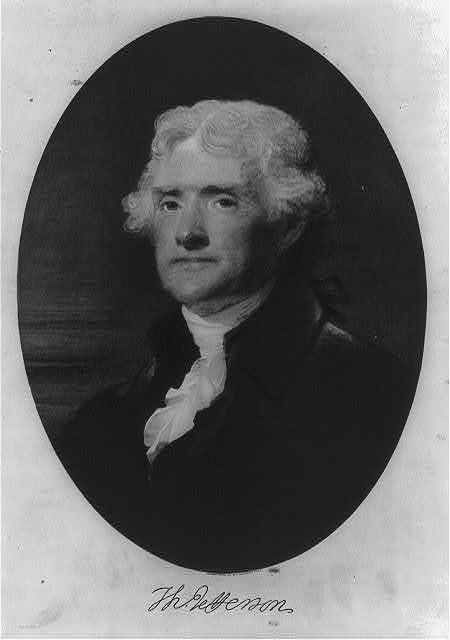
Five primary documents from forty-three years, 1743 to 1786. The education he gave himself. The Declaration he wrote and what Congress changed. The architecture he taught himself and began building at twenty-five. The Virginia Statute for Religious Freedom. The Notes on the State of Virginia, the only book he published, and the one that documents his views on slavery and race alongside his views on divine justice.
Thomas Jefferson was born April 13, 1743 at Shadwell, Virginia. His father Peter Jefferson was a surveyor and planter who died when Jefferson was fourteen, leaving him 2,750 acres and the enslaved people who worked them. Jefferson entered the College of William and Mary in 1760 at age seventeen and studied under William Small, a Scottish professor of natural philosophy who introduced him to the work of Bacon, Newton, and Locke. He read law under George Wythe, the episode on Wythe is in the Forgotten Founders archive. He was admitted to the Virginia bar in 1767.
What the primary record documents about Jefferson's self-education goes beyond his formal schooling. He learned Greek, Latin, French, Italian, Spanish, and Anglo-Saxon, the last largely on his own. He taught himself architecture from Andrea Palladio's Four Books of Architecture and James Gibbs's Book of Architecture. He taught himself calculus from Newton's Principia. He designed his own home, his own furniture, his own scientific instruments. He catalogued his own library, which eventually became the foundation of the Library of Congress after the British burned it in 1814. His book catalogue is at the Library of Congress.
Jefferson was appointed to the Committee of Five on June 11, 1776. John Adams later wrote that Jefferson had "a peculiar felicity of expression" and was urged to write the draft. Jefferson wrote it in seventeen days, working in rented rooms at Market and Seventh Streets in Philadelphia. The original rough draft manuscript is at the Library of Congress. It shows Jefferson's handwriting alongside the changes Congress made.
Congress changed "sacred and undeniable" to "self-evident." They struck approximately a quarter of Jefferson's draft. Congress also struck a lengthy denunciation of the slave trade, Jefferson called it a crime "against human nature itself" and blamed it on the British Crown. South Carolina and Georgia delegates insisted on its removal. Jefferson documented this in his Notes on Proceedings, which are at Founders Online.
We hold these truths to be self evident; that all men are created equal; that they are endowed by their creator with certain unalienable rights; that among these are life, liberty, & the pursuit of happiness; that to secure these rights, governments are instituted among men, deriving their just powers from the consent of the governed.
Jefferson began planning Monticello in 1768 and broke ground in 1769 at age twenty-five. He had no formal architectural training. He taught himself from Palladio's Four Books of Architecture and Gibbs's Book of Architecture, pattern books of classical design. He chose the mountaintop site against conventional practice, which favored lower ground. He called it "my essay in architecture."
The first version of Monticello, a two-story Palladian structure, was largely complete by 1782. Jefferson would rebuild it substantially between 1796 and 1809 after seeing French architecture during his time as Minister to France. The dome, the first on an American private residence, was added in the rebuilding. Jefferson worked on Monticello for fifty-four years. The architectural drawings in his own hand are at the Massachusetts Historical Society and the Library of Congress. Encyclopedia Virginia documents the full construction history at a confirmed institutional URL.
The genius of Architecture seems to have shed its maledictions over this land. Buildings are often erected, by individuals, of considerable expence. To give these symmetry and taste would not increase their cost. It would only change the arrangement of the materials, the form and combination of the members. This would often cost less than the burthen of barbarous ornaments with which these buildings are sometimes charged.
Jefferson was writing about Virginia's public buildings, specifically the Governor's Palace in Williamsburg, but the critique applied to his own era's architectural standards broadly. He believed architecture was a public good: that the buildings of a republic should express republican values. The University of Virginia campus, which he designed fifty years later, was his fullest expression of that belief. Both are in the primary record.
Jefferson drafted the Virginia Statute for Religious Freedom in 1777. It was not passed for nine years, Patrick Henry blocked it repeatedly in the Virginia legislature. James Madison finally shepherded it through in January 1786 while Jefferson was in Paris as Minister to France. Jefferson later listed it on his tombstone as one of the three achievements he wanted to be remembered for, alongside the Declaration and the University of Virginia. He did not list his presidency.
Be it enacted by the General Assembly, That no man shall be compelled to frequent or support any religious worship, place, or ministry whatsoever, nor shall be enforced, restrained, molested, or burthened in his body or goods, nor shall otherwise suffer on account of his religious opinions or belief; but that all men shall be free to profess, and by argument to maintain, their opinion in matters of religion, and that the same shall in no wise diminish, enlarge, or affect their civil capacities.
The statute's preamble, Jefferson's own language, argued that "Almighty God hath created the mind free" and that any attempt to compel religious conformity was "a departure from the plan of the holy author of our religion." Jefferson used religious language to argue for religious freedom. He wrote from Paris to Madison on the statute's passage: "It is comfortable to see the standard of reason at length erected, after so many ages during which the human mind has been held in vassalage by kings, priests, and nobles." The letter is at Founders Online.
Jefferson began writing Notes on the State of Virginia in 1781 in response to questions from the French legation about Virginia. He privately printed it in Paris in 1785 and published it publicly in 1787. It is the only full-length book he published in his lifetime. He addressed slavery, race, architecture, natural history, law, religion, and the geography of Virginia. The book covers natural history, law, religion, architecture, and the geography of Virginia.
In Query XIV, Jefferson wrote about what he called "the real distinctions which nature has made" between races, passages arguing for the intellectual inferiority of Black people that he acknowledged were "hazarded with great diffidence." In Query XVIII, written in the same book, he wrote about slavery and divine justice.
Indeed I tremble for my country when I reflect that God is just: that his justice cannot sleep for ever: that considering numbers, nature and natural means only, a revolution of the wheel of fortune, an exchange of situation, is among possible events: that it may become probable by supernatural interference! The Almighty has no attribute which can take side with us in such a contest.
Jefferson writes of "the real distinctions which nature has made" between races and suggests, "with great diffidence," that Black people may be intellectually inferior to white people "in the endowments both of body and mind."
"I tremble for my country when I reflect that God is just... The Almighty has no attribute which can take side with us in such a contest."
If you learned something new or just enjoyed the content, please share it and follow along on X and Substack. This page runs on a passion for our shared history, and a steady supply of caffeine. If you're able, consider buying a coffee. It goes a long way toward keeping the content coming, and helps the project grow into new mediums down the road. My sincere thanks.