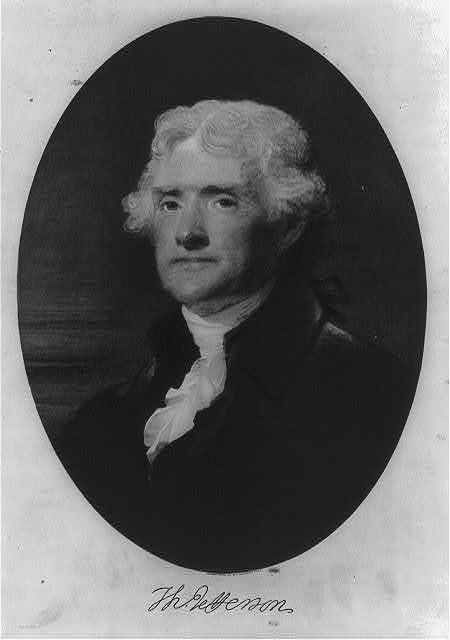
From 1809 to 1826 Thomas Jefferson lived in retirement at Monticello. The primary documents from these years include his design and founding of the University of Virginia, his private compilation of the moral teachings of Jesus, and his final correspondence. He died on July 4, 1826, the fiftieth anniversary of the Declaration of Independence.
Jefferson chose three achievements for his tombstone, author of the Declaration of Independence, author of the Virginia Statute for Religious Freedom, and father of the University of Virginia. He did not list his presidency. The University of Virginia was the last of the three. Jefferson listed it on his tombstone alongside the Declaration and the Virginia Statute, and did not list his presidency.
Jefferson conceived, designed, funded, and oversaw the construction of the University of Virginia from 1817 to his death in 1826. He designed the Academical Village, the Rotunda based on the Pantheon in Rome at half scale, ten pavilions housing faculty and classrooms arranged in a colonnade, student rooms connecting them, and serpentine walls enclosing the gardens. He supervised the construction from Monticello, riding to the site regularly. He selected the faculty from Europe, designed the curriculum, and chose the books. He called the campus "the hobby of my old age." In 1987, Monticello and the University of Virginia Academical Village together were named a UNESCO World Heritage Site. Jefferson's correspondence with the architects and builders is at Founders Online.
This institution will be based on the illimitable freedom of the human mind. For here we are not afraid to follow truth wherever it may lead, nor to tolerate any error so long as reason is left free to combat it.
The primary record contains Jefferson's statements on religion spanning more than thirty-five years. Below are six documents presented in chronological order. The reader may compare them directly.
"Fix reason firmly in her seat, and call to her tribunal every fact, every opinion. Question with boldness even the existence of a god; because, if there be one, he must more approve the homage of reason, than that of blindfolded fear." founders.archives.gov/documents/Jefferson/01-12-02-0021
"In a comparative view of the Ethics of the enlightened nations of antiquity, of the Jews, and of Jesus, no notice should be taken of the corruptions of reason among the ancients, to wit, the idolatry & superstition of the vulgar, nor of the corruptions of Christianity by the learned among its professors. Jesus corrected the Deism of the Jews, confirming them in their belief of one only god... His moral doctrines, relating to kindred & friends, were more pure & perfect than those of the most correct of the philosophers." founders.archives.gov/documents/Jefferson/01-40-02-0178-0002 · Jefferson shared this with fewer than a dozen correspondents. He never published it.
"I am of a sect by myself, as far as I know. I am not a Jew, and yet I am the disciple of Jesus, more than all the Bishops and Clergy of Christendom. I am indeed opposed to all interested and fanatical sects, but I am not opposed to the genuine precepts of Jesus himself. I am a Christian, in the only sense in which he wished any one to be; sincerely attached to his doctrines, in preference to all others; ascribing to himself every human excellence; and believing he never claimed any other." founders.archives.gov/documents/Jefferson/03-06-02-0431
Jefferson took six copies of the New Testament in Greek, Latin, French, and English. He cut passages from each with a razor and arranged the moral teachings of Jesus in parallel columns, omitting every miracle and the resurrection. He titled the result "The Life and Morals of Jesus of Nazareth." He kept it private. He never published it. The original is held by the Smithsonian National Museum of American History. amhistory.si.edu/documentsgallery/exhibitions/jefferson/index.html
"I can never join Calvin in addressing his god. he was indeed an Atheist, which I can never be; or rather his religion was Dæmonism. If ever man worshipped a false god, he did. The being described in his 5. points is not the God whom you and I acknowledge and adore, the Creator and benevolent governor of the world; but a Dæmon of malignant spirit." founders.archives.gov/documents/Jefferson/03-19-02-0400
"This letter will, to you be as one from the dead, the writer will be in the grave before you can weigh it's counsels... adore God. reverence and cherish your parents. love your neighbor as yourself, and your country more than yourself. be just. be true. murmur not at the ways of Providence. so shall the life into which you have entered be the Portal to one of eternal and ineffable bliss." founders.archives.gov/documents/Jefferson/98-01-02-4987
All six documents are at the linked institutional archives. The reader may compare them directly.
Jefferson and Adams resumed correspondence in 1812 after a decade of silence following the bitterly contested election of 1800. Their exchange over the next fourteen years, 158 letters, covers religion, philosophy, natural history, politics, and aging. The October 12, 1813 letter addresses his theological position directly.
I am of a sect by myself, as far as I know. I am not a Jew, and yet I am the disciple of Jesus, more than all the Bishops and Clergy of Christendom. I am indeed opposed to all interested and fanatical sects, but I am not opposed to the genuine precepts of Jesus himself. I am a Christian, in the only sense in which he wished any one to be; sincerely attached to his doctrines, in preference to all others; ascribing to himself every human excellence; and believing he never claimed any other.
On February 21, 1825, Jefferson wrote a young man named Thomas Jefferson Smith, his namesake, at the request of the boy's father. Jefferson was eighty-one years old. He acknowledged from the letter's opening that the boy would likely read it after Jefferson was dead.
This letter will, to you be as one from the dead, the writer will be in the grave before you can weigh it's counsels. your affectionate and excellent father has requested that I would address to you something which might possibly have a favorable influence on the course of life you have to run... adore God. reverence and cherish your parents. love your neighbor as yourself, and your country more than yourself. be just. be true. murmur not at the ways of Providence. so shall the life into which you have entered be the Portal to one of eternal and ineffable bliss.
Jefferson was eighty-three years old, $107,000 in debt, and in failing health. He had been invited to Washington for the fiftieth anniversary celebration of the Declaration of Independence. He could not attend. He wrote Roger Weightman, the mayor of Washington, on June 24, 1826. It was the last letter he wrote. He died ten days later.
May it be to the world what I believe it will be (to some parts sooner, to others later, but finally to all) the Signal of arousing men to burst the chains under which monkish ignorance and superstition had persuaded them to bind themselves, and to assume the blessings and security of self-government... All eyes are opened, or opening, to the rights of man. The general spread of the light of science has already laid open to every view the palpable truth, that the mass of mankind has not been born with saddles on their backs, nor a favored few booted and spurred, ready to ride them legitimately, by the grace of God.
Thomas Jefferson died at Monticello at approximately 12:50 in the afternoon on July 4, 1826, the fiftieth anniversary of the Declaration of Independence. John Adams died the same day in Quincy, Massachusetts. Adams's last words were reported as "Thomas Jefferson survives." He did not know Jefferson had already died that morning.
"Question with boldness even the existence of a god; because, if there be one, he must more approve the homage of reason, than that of blindfolded fear."
"adore God. reverence and cherish your parents. love your neighbor as yourself... murmur not at the ways of Providence."
If you learned something new or just enjoyed the content, please share it and follow along on X and Substack. This page runs on a passion for our shared history, and a steady supply of caffeine. If you're able, consider buying a coffee. It goes a long way toward keeping the content coming, and helps the project grow into new mediums down the road. My sincere thanks.