Every prior episode in this season has shown a piece of this. This finale puts the pieces together: who actually went to college, who did not, and why the founding generation believed neither answer excused a citizen from being educated.
Independently verified across the 56 signers of the Declaration of Independence: 29 attended some form of college. 27 did not. The 29 did not cluster at one or two schools. They spread across Harvard, William and Mary, the College of New Jersey at Princeton, the College of Philadelphia, King's College, and in several cases European universities entirely, Edinburgh, Glasgow, St. Andrews, even a Jesuit college in France for Charles Carroll of Carrollton. There was no single path through the classical track. There were many, and most of them cost money few families had.
Episode 05 covered Adams's own account of his Harvard entrance exam. Harvard's 1767 Laws survive in full, the formal version of exactly what he described living through.
When any Schollar is able to read and Construe and Parse Tully, Virgil or such like common Classical Latin Authors, and to write True Latin in Prose, and to be Skilled in making Latin Verse... and decline perfectly the Paradigm's of Nouns and Verbs in the Greek Tongue, he shall be Capable of Admission into Harvard-College.
Four signers attended William and Mary, the second-oldest college in British North America, chartered by King William III and Queen Mary II to train ministers, propagate the Christian faith, and educate Virginia's youth in good letters. By the founding era it had already produced a record few American colleges could match: the nation's first student honor code, the first professor of law in America (George Wythe, appointed at Jefferson's own urging in 1779), and a faculty and alumni list running through three future presidents, sixteen members of the Continental Congress, and four Supreme Court justices, including John Marshall.
Jefferson's own time there, in the 1760s, coincided with a genuinely difficult period for the college, an ongoing governance dispute between the faculty and the Board of Visitors that the institution's own published history records as having weakened student discipline for a stretch of years. It was not the college's defining era, but it was Jefferson's, and it shapes how his particular education actually happened.
Episode 05 already told the more personal side of this: Jefferson's own good fortune in finding, at William and Mary, an exceptional mentor in mathematics professor William Small, who taught him through ongoing daily conversation rather than recitation alone. Jefferson's own words are warm on the subject, he credited Small directly with fixing the destinies of his life. That relationship stayed with him; later in his career he urged the college to appoint his friend George Wythe as America's first law professor, and he remained invested enough in William and Mary's curriculum to push for its continued growth himself.
John Witherspoon became president of the College of New Jersey in 1768 and was, himself, a signer of the Declaration, the only college president and the only minister to sign it. Two more signers passed directly through his classroom: Benjamin Rush, who graduated at fourteen, and Richard Stockton, a college trustee. Witherspoon tightened academic standards, broadened the curriculum beyond clergy training into a generation of secular national leadership, and his students went on to fill the Constitutional Convention itself, nine Princeton alumni attended in 1787, more than from any other American or British institution.
Twenty-seven signers never attended college. Franklin, already covered in Episode 05, had two years of formal schooling before his apprenticeship became his real education. Roger Sherman could not afford college at all. Neither man was uneducated. Both came up through the same primary system this entire season has documented: Webster's speller, which by Episode 01's own circulation data reached an estimated five generations of American children; readers like Bingham's Columbian Orator, built explicitly, in its own subtitle, to improve "Youth and Others in the Ornamental and Useful Art of Eloquence," not just the college-bound.
The literacy that primary system produced is itself the strongest evidence against treating the non-college half as uneducated. Colonial New England's documented literacy rate ran an estimated 85 to 90 percent. The current U.S. national adult literacy rate, measured by functional reading comprehension, is 79 percent. Even New Hampshire, the highest-ranked state in the country today, runs close to or only modestly above what colonial New England had already achieved, without a public school system, two and a half centuries earlier.
What that primary-level education actually produced, in practice, is easier to show than to argue. Franklin never attended college at all. Madison, by contrast, did, he is one of the 29, a Princeton graduate already profiled in Episode 05. The two men are placed side by side here for a different reason: both became two of the era's most prolific working authors, and the documented record of what they actually wrote is itself primary-source evidence of what this education, college and non-college alike, was capable of producing.
| Author | Work | Record |
|---|---|---|
| Franklin | Poor Richard's Almanack | 26 annual issues, 1732-1758, ~10,000 copies a year |
| Franklin | The Pennsylvania Gazette | Owned and edited from 1729 |
| Franklin | Autobiography | Written 1771-1789, original manuscript survives |
| Madison | Notes of Debates in the Federal Convention | Kept daily, summer 1787, unpublished until after his death |
| Madison | The Federalist Papers | Contributed a substantial share of the 85 essays, Oct. 1787-May 1788 |
Jefferson himself supplied the argument for why this mattered beyond any individual's career. In 1779 he introduced a bill in the Virginia General Assembly that he privately called, in a letter to George Wythe, the most important bill in his state's entire legal code, more important, in his own ranking, than the Declaration itself. It proposed free public education, funded by taxpayers, for all children, "male and female."
Experience hath shewn, that even under the best forms [of government], those entrusted with power have, in time, and by slow operations, perverted it into tyranny; and it is believed that the most effectual means of preventing this would be, to illuminate, as far as practicable, the minds of the people at large.
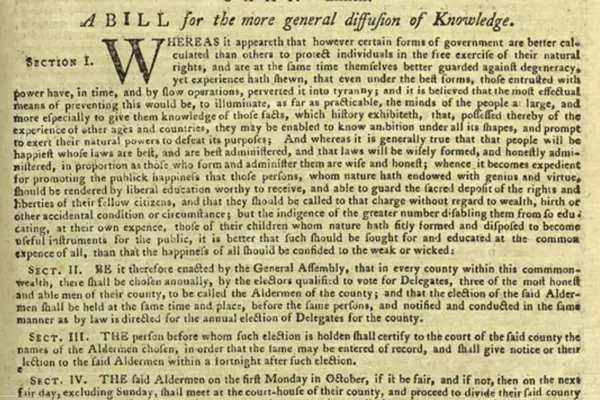
Read plainly, the argument is not that education makes citizens more refined. It is that self-government cannot survive without it. A republic has no king to restrain its own officeholders; the only available check is a citizenry educated enough to recognize tyranny before it takes hold and to argue against it in public, in print, in town meetings and assemblies, before it becomes irreversible. That is what the rhetoric training in Bingham's reader, the literacy built by Webster's speller, and the disputations required at every college this episode covers were actually preparing people to do. Not to perform learning. To debate, in public, as a civic duty every citizen, college-educated or not, man or woman, was expected to be capable of.
"Education is not a social good. It is a political defense mechanism."