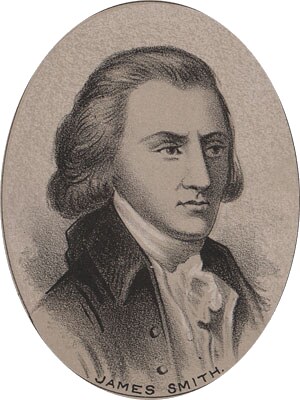
Three primary documents from the Irish immigrant lawyer who organized York's militia, signed the Declaration, read it in the town square, and had his entire paper record erased by fire a year before his death.
James Smith was born around 1719 in Ulster, Ireland, the second son of a farmer. His exact birth date is uncertain, Smith was known for refusing to confirm his age to those who asked, treating it as a private joke. His family emigrated to Chester County, Pennsylvania around 1729. He received a classical education from a local minister, studied law at his brother George's office in Lancaster, and was admitted to the Pennsylvania bar in 1745.
After years of frontier surveying and a slow legal practice near Shippensburg, Smith relocated to York, Pennsylvania, where he eventually became the town's leading lawyer. He organized a volunteer militia company in York in 1774 and was elected its captain. He was appointed to the Pennsylvania provincial convention in 1775 and was elected to the Continental Congress in July 1776.
The original Pennsylvania delegation to the Continental Congress refused to vote for independence. The Pennsylvania Assembly recalled those delegates and sent five new men who would support it, James Smith was one of them. He was elected on July 20, 1776, sixteen days after July 4. He signed the Declaration of Independence on August 2, 1776.
On July 6, 1776, Smith rode to York's town square and read aloud a printed copy of the Declaration to the assembled citizens of York, one of the earliest public readings of the Declaration in any American town. He served in Congress through early 1777, sitting on the Board of War.
James Smith was a lawyer who signed the Declaration and then rode with a printed copy of it to read publicly in York's town square on July 6, 1776.
Smith served as a judge of the Pennsylvania High Court of Errors and Appeals from 1780 to 1781. He was appointed brigadier general of the Pennsylvania Militia in 1782. He was reelected to Congress in 1785 but declined to attend because of his advanced age. He continued practicing law until nearly eighty.
In 1805, a fire destroyed his office and all of his papers. This is why so little primary documentation survives about Smith's life and career. The fire consumed correspondence, legal records, and personal papers accumulated over sixty years of public life. He died on July 11, 1806, in York, Pennsylvania. He is buried at First Presbyterian Churchyard in York.
If you learned something new or just enjoyed the content, please share it and follow along on X and Substack. This page runs on a passion for our shared history, and a steady supply of caffeine. If you're able, consider buying a coffee. It goes a long way toward keeping the content coming, and helps the project grow into new mediums down the road. My sincere thanks.