What the Armies Carried, Ate, and Were Required to Do
Arms and Rations: Equipping the Armies of the Revolution
Three armies fought across the battles in this series, American, British, and after 1778, French, and each carried different muskets, drew different rations, and held its soldiers to different standards. This companion page lays out the comparison, sourced to the U.S. Army's own historical office and the Smithsonian's National Museum of American History, which holds an actual American-stamped French musket in its collection.
01
What the Army Required
Establishing the Continental Army.
Congress made the New England militia surrounding Boston a national army on June 14, 1775, and gave George Washington his commission two days later. The standard first oath of enlistment, adopted that same week, bound a soldier to one year of service and to whatever rules and regulations the army established. On the march, that soldier carried 45 to 60 pounds of gear: musket, bayonet, knapsack, haversack, ammunition, and a blanket, among other items judged essential. Uniforms varied widely by state and by year. Congress settled on blue as the Continental Army's official coat color only in 1779, and dye shortages meant many regiments wore brown or green well past that point.
Enlistment policy toward Black soldiers shifted more than once in the war's first year, and the documents survive in Washington's own hand. On November 12, 1775, Washington issued an order barring further Black enlistment, lumping the policy in with bans on underage boys and men too old for campaign duty.
"
Neither Negroes, Boys unable to bare Arms, nor old men unfit to endure the fatigues of the campaign, are to be inlisted.
George Washington, General Orders · November 12, 1775 · Founders Online, National ArchivesFounders Online → →
Within seven weeks, Washington reversed course for soldiers already serving. His letter to Congress president John Hancock explains why in his own words.
"
It has been represented to me that the free negroes who have served in this Army, are very much dissatisfied at being discarded. As it is to be apprehended that they may seek employ in the ministerial Army, I have presumed to depart from the resolution respecting them, and have given license for their being enlisted. If this is disapproved of by Congress, I will put a stop to it.
George Washington to John Hancock · December 31, 1775 · Founders Online, National ArchivesFounders Online → →
The Honest Record
Congress did not give Washington a clean answer. On January 16, 1776, it resolved that free Black soldiers who had already served faithfully could reenlist, but explicitly barred any new Black enlistments, free or enslaved. That compromise, allow the veterans back, take no new recruits, remained official policy for the rest of the war. In practice, manpower shortages and the difficulty of verifying any individual recruit's enlistment history meant the policy was unevenly enforced, and Black soldiers, free and enslaved, continued to serve throughout the war in numbers beyond what the official record alone would suggest.
02
The Muskets
Three Armies, Three Standard Arms.
All three armies that appear across this series relied on smoothbore, muzzle-loading flintlock muskets as their standard infantry arm, weapons that prioritized rate of fire and bayonet readiness over precision. The Smithsonian's National Museum of American History holds original examples of both the British and French muskets described below, including a French musket physically stamped "US" for Continental Army service.
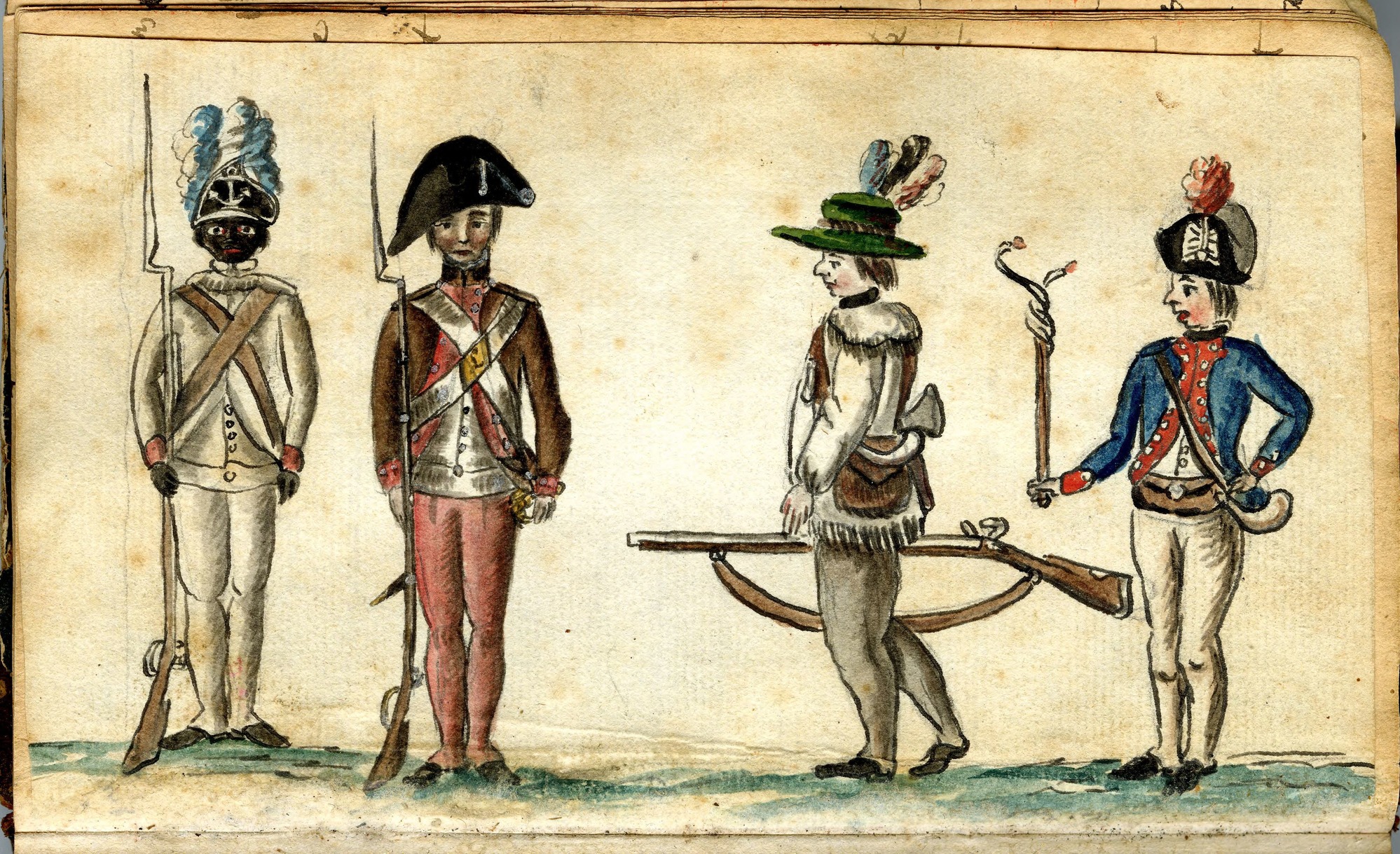
"Soldiers in Uniform," painted from life near Yorktown in 1781 by Jean Baptiste Antoine de Verger, a French sub-lieutenant serving under Rochambeau. Left to right: a soldier of the 1st Rhode Island Regiment, a New England militiaman, a frontier rifleman, and a French officer. Public domain, Library of Congress / Anne S.K. Brown Military Collection, via NPS Gallery.
British
Brown Bess
Pattern: Short Land Pattern musket
Caliber: approx. .75 in (Smithsonian's own example: .71 to .78 in across surviving pieces)
Length: approx. 61 in
Rate of fire: 3 to 4 rounds per minute
Standard arm of the British infantryman throughout the war. The Smithsonian's own description calls it slow to load, inaccurate, and frequently unreliable, which is why infantry fought massed together rather than aiming individually.
American
Mixed Arms
Pattern: Captured Brown Bess, French Charleville (from 1777), and locally made "Committee of Safety" muskets
Caliber: varied, .69 to .75 in depending on source
Rate of fire: approx. 3 rounds per minute, trained infantry
The Continental Army had no standard musket of its own through most of the war. Riflemen carried Pennsylvania long rifles, accurate to 200 to 300 yards but slow to reload and rarely fitted with a bayonet. See the watercolor above for how varied this actually looked in the field.
French
Charleville
Pattern: Model 1763 / 1766, supplied to American forces; Model 1777 used only by French troops under Rochambeau
Caliber: .69 in
Length: approx. 59.5 in
Lighter than the Brown Bess by design. France shipped roughly 25,000 Charleville muskets to Portsmouth, New Hampshire in March 1777 alone. Washington had incoming French muskets stamped "US" on the lock plate to reduce theft and identify Continental property. The example pictured here is that exact kind of stamped musket.
The Smithsonian's catalog entry for its French Charleville notes that several French arsenals produced muskets for the army, but the Model 1763 was so common that American troops came to call all French muskets "Charlevilles" regardless of which model they actually carried, a naming habit that has stuck in popular use ever since.
03
Rations
What a Soldier Was Owed, and What He Usually Got.
The Continental Army's authorized daily ration, set in November 1775, looked generous on paper. In practice, shortages were constant, and most soldiers received well below what regulations promised. The U.S. Army's own historical office, the Center of Military History, has published the authorized scale as it stood that winter.
Item
Authorized Amount
Bread or flour
1 pound per day
Beef, fish, or pork
1 lb beef / 1 lb fish / ¾ lb pork per day
Peas, beans, or vegetable equivalent
3 pints per week
Milk
1 pint per day
Rice or Indian meal
½ pint per day
Spruce beer or cider
1 quart per day, or molasses equivalent
Candles
3 pounds per company, per week
Soap
24 lb soft or 8 lb hard, per company, per week
An amended ration that December authorized corned beef or pork four days a week, salted fish one day, and fresh beef two days, with the meat allowance increased in winter months when milk was unavailable. Field rations, as opposed to what a garrisoned fort might receive, generally meant dried bread, called ship's biscuit, salted meat, and dried peas. When shortages hit, commissaries authorized substitutions: a full day's ration of bread and pork alone, with no other items, might mean two pounds of bread and one pound of pork and nothing else.
Ship's Biscuit
The standard field bread of the Continental Army: flour, water, and time. Sturdy enough to survive a campaign, soaked in water, milk, or stew before eating.
Ingredients (makes 3 to 5 biscuits)
2 cups flour
1 cup plus 2 tablespoons water
Method
Preheat an oven to 375°F (190°C).
Mix the flour and water into a stiff dough. Let it rest at least 10 minutes, then knead well, turning the dough inside out, until smooth and even.
Form the dough into 3 to 5 balls. Roll each into a disc about ½ inch thick and 3¾ inches across. If the edges crack, knead the dough back together and try again.
Poke holes through each disc in a grid pattern, about ¾ inch apart.
Bake for 1 hour, opening the oven periodically to let moisture escape.
Let the baked biscuit stand in open air for several days to continue drying, then store somewhere dry. To eat, soak in water, milk, or stew for 10 to 15 minutes.
Six primary source manuscripts that were overlooked, misdated, or nearly erased from the record. Verified against institutional archives. Free with your email, along with new episodes as they post.
No spam. Unsubscribe any time. PDF delivered instantly via Substack.