The Federalist Papers argued for ratification. The Anti-Federalists argued against it, not from ignorance of the Constitution but from a specific reading of what it would do. George Mason had been in the room when it was drafted. Elbridge Gerry had been there too. Both refused to sign. Their objections are documented. This episode covers their case.
The Constitution was signed September 17, 1787 and sent to the states for ratification. The debate that followed was conducted largely in print. Hamilton, Madison, and Jay published 85 essays as Publius in four New York newspapers between October 1787 and May 1788. The Anti-Federalist response was substantial: essays, letters, and pamphlets published under names including Brutus, Federal Farmer, Centinel, and the Federal Republican, appearing across multiple states throughout the same period. Most Anti-Federalist authors wrote anonymously. Their identities are disputed to this day.
The Anti-Federalist case rested on three primary objections. First, the Constitution lacked a Bill of Rights. Second, the central government was too powerful and would eventually absorb the states. Third, the republic was too large: a government covering thirteen states could not remain responsive to the people. George Mason, who had refused to sign the Constitution on September 17, published his objections as a broadside. Elbridge Gerry published his. The Federal Farmer, whose authorship remains disputed among Richard Henry Lee, Melancton Smith, and Elbridge Gerry, published eighteen letters beginning October 8, 1787.
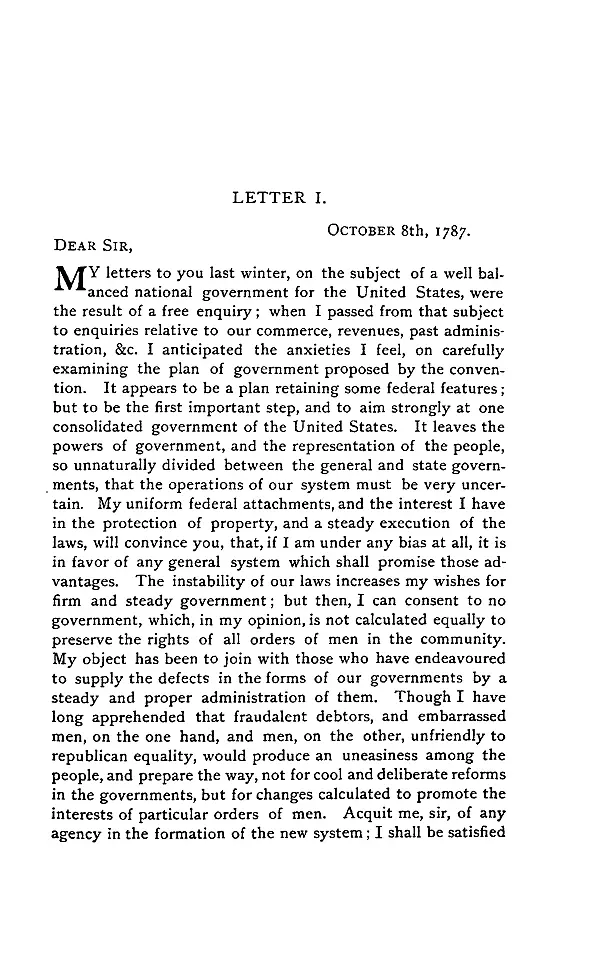
My letters to you last winter, on the subject of a well balanced national government for the United States, were the result of a free enquiry; when I passed from that subject to enquiries relative to our commerce, revenues, past administration, etc. I anticipated the anxieties I feel, on carefully examining the plan of government proposed by the convention.
George Mason's objections ran to sixteen points. They included the absence of a declaration of rights, the scope of congressional taxing power, the structure of the federal judiciary, the executive's lack of a council, the treaty power shared between the President and Senate, and the absence of restrictions on a standing army. Mason's objection about the Bill of Rights was directly addressed at the Virginia ratification convention and became the basis for Madison's introduction of the first ten amendments in June 1789.
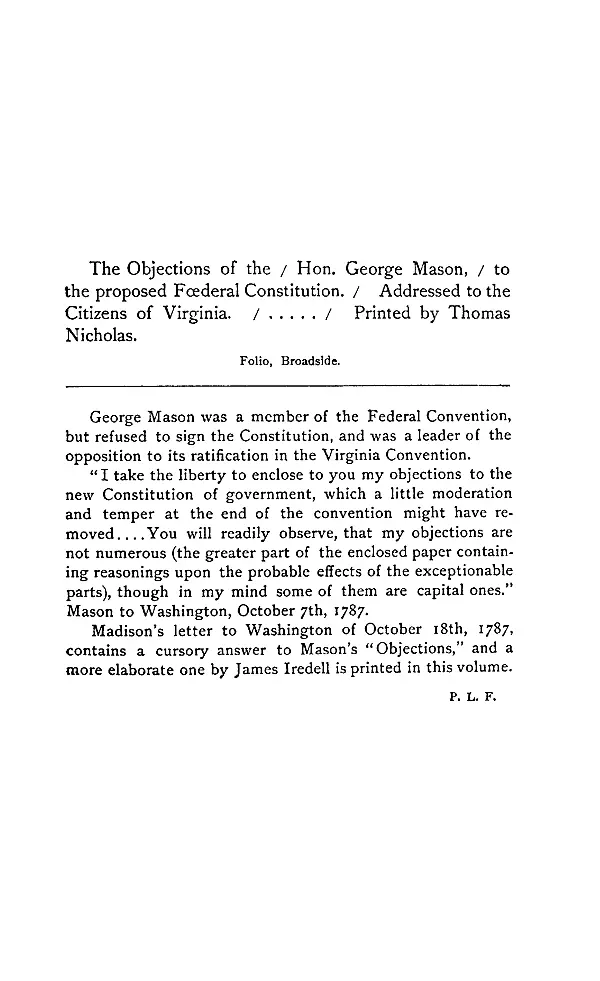
There is no declaration of rights, and the laws of the general government being paramount to the laws and constitutions of the several states, the declarations of rights in the separate states are no security.
Nine states ratified between December 1787 and June 1788. Delaware ratified first on December 7, 1787. New Hampshire was the ninth on June 21, 1788, providing the threshold for the Constitution to take effect. Virginia ratified four days later on June 25. New York followed on July 26. North Carolina and Rhode Island did not ratify until after the new government had already begun operating.
If you learned something new or just enjoyed the content, please share it and follow along on X and Substack. This page runs on a passion for our shared history. If you're able, consider buying a coffee.