The Convention had been in session since May 25, 1787, a span of 116 days. On the last morning, the delegates gathered to sign or refuse. Franklin's speech was written out and handed to James Wilson, who read it aloud while Franklin sat. The Convention then adjourned sine die, Latin for "without a day," meaning permanently, with no date set to reconvene.
The final session opened with a procedural motion. Gouverneur Morris had drafted an ambiguous signing formula designed to allow delegates with reservations to attach their names without pledging personal approval. The formula read: "Done in Convention, by the unanimous consent of the States present the 17th of September." It was given to Franklin to introduce, Madison recorded, so that it "might have the better chance of success." Wilson read it aloud as Franklin's motion.
Thirty-nine delegates signed. New Hampshire, Massachusetts, Connecticut, New Jersey, Pennsylvania, Delaware, Maryland, Virginia, North Carolina, South Carolina, and Georgia all returned unanimous state delegations. New York had only one delegate present. Alexander Hamilton signed alone, as Yates and Lansing had left the Convention in July and did not return. He noted in the record that he was doing so as an individual rather than as a state representative.
Three delegates present refused to sign: George Mason of Virginia, Elbridge Gerry of Massachusetts, and Edmund Randolph of Virginia. Mason's objections included the absence of a Bill of Rights, the scope of congressional power, and the structure of the Senate. Gerry's objections were similar. Randolph said he could not sign without the ability to place his objections before his state, but did not commit to opposing ratification.
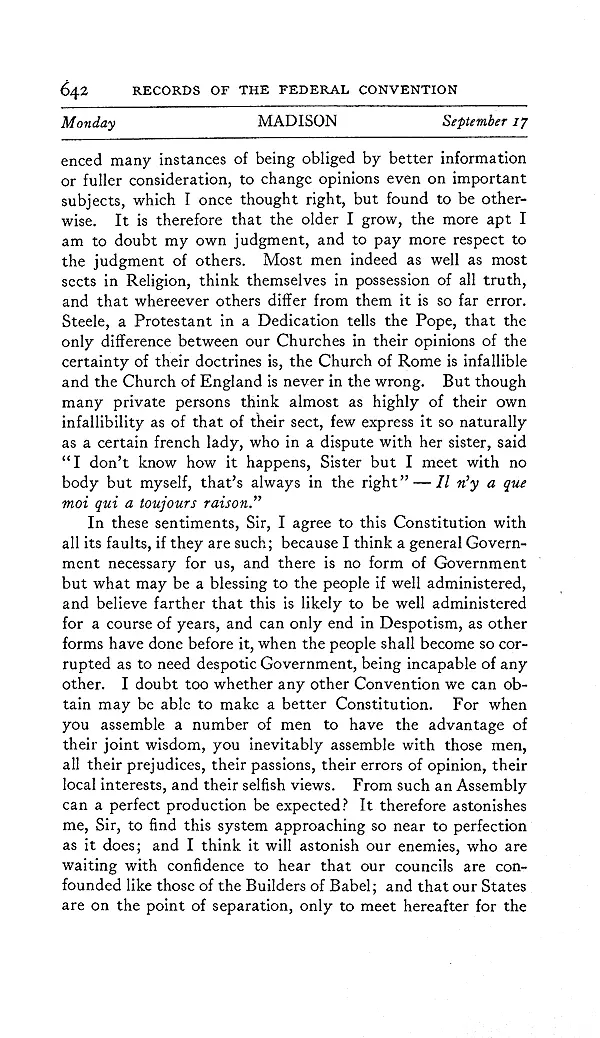
Benjamin Franklin was 81 years old on September 17, 1787. He had attended the Convention regularly but could not deliver a speech from a standing position. He wrote out his remarks and gave them to James Wilson of Pennsylvania to read aloud. The speech is recorded in Madison's Notes for September 17.
Franklin opened by saying that he could not help expressing surprise that the Constitution approached so near to perfection. He then addressed the dissenters directly, arguing that no man could be certain of his own judgment, and that he had himself often been compelled to revise opinions he once held as correct.
Thus I consent, Sir, to this Constitution because I expect no better, and because I am not sure, that it is not the best. The opinions I have had of its errors, I sacrifice to the public good, I have never whispered a syllable of them abroad, Within these walls they were born, and here they shall die.
Franklin closed by moving that every member still holding objections would "doubt a little of his own infallibility" and sign the instrument to make manifest their unanimity. The motion was then put. The Constitution was signed. The Convention adjourned.
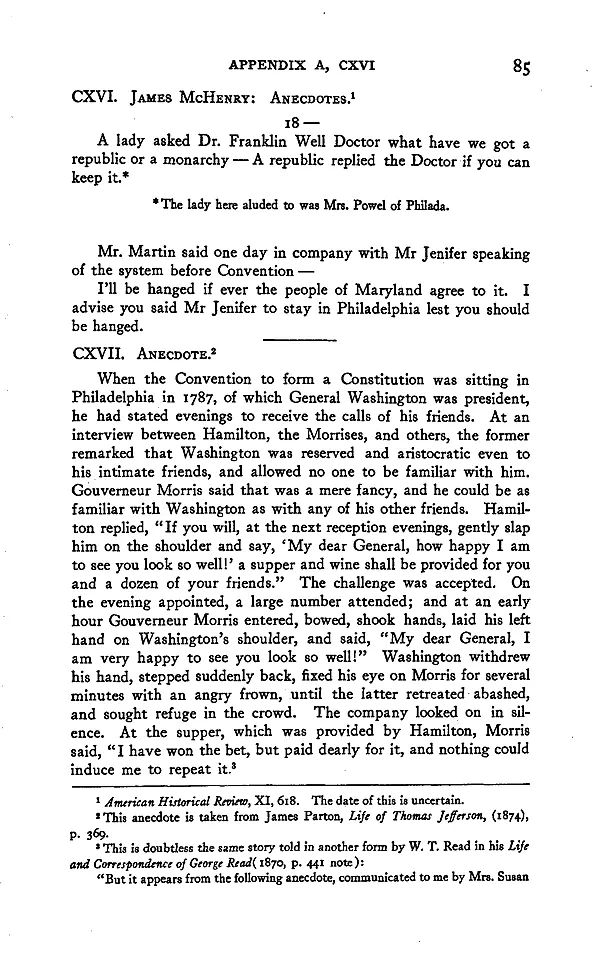
James McHenry was a Maryland delegate to the Convention. He kept his own journal of proceedings, portions of which were later published by historians and compiled by Max Farrand in The Records of the Federal Convention. In Volume III, Appendix A, McHenry recorded a collection of anecdotes from the Convention period under the heading "CXVI. James McHenry: Anecdotes."
The anecdote appears without a precise date. The lady McHenry identified in a footnote was Elizabeth Willing Powel of Philadelphia, a prominent figure in Philadelphia society who regularly hosted Convention delegates at her home. McHenry noted her identity in a footnote: "The lady here aluded to was Mrs. Powel of Philada."
A lady asked Dr. Franklin Well Doctor what have we got a republic or a monarchy, A republic replied the Doctor if you can keep it.
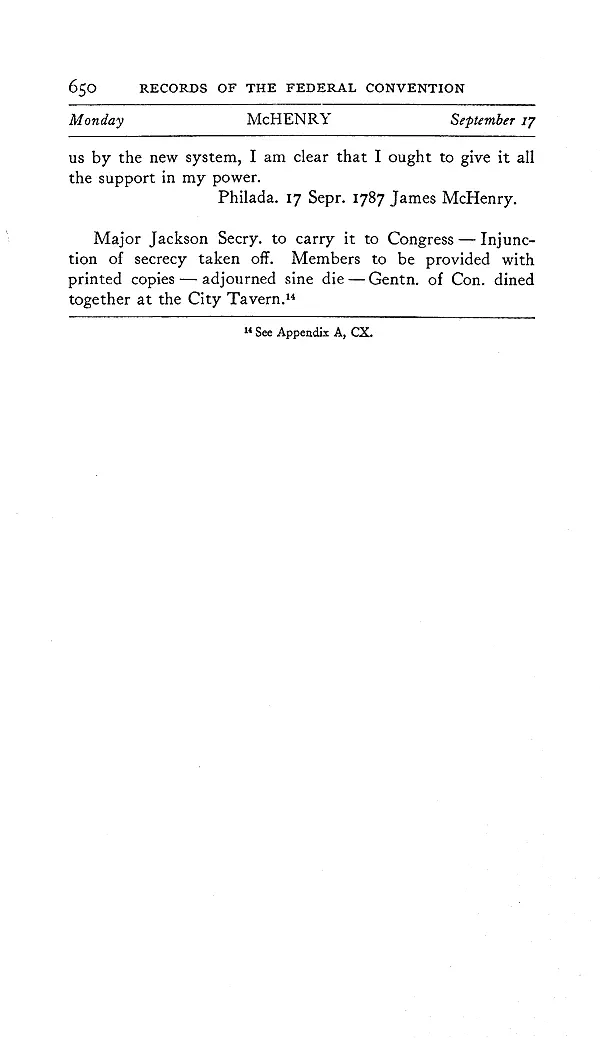
Four primary sources document September 17, 1787. The official Journal records the vote: the Constitution unanimously agreed to by the states present. Madison's Notes record the floor proceedings: the signing formula motion, Franklin's speech as read by Wilson, the objections of Mason, Gerry, and Randolph, and the final vote. McHenry's journal for September 17 records the procedural close: the injunction of secrecy lifted, printed copies ordered, adjournment sine die (no date to reconvene), and the delegates dining together at the City Tavern. The anecdote with Mrs. Powel appears separately in McHenry's appendix, without a confirmed date.
Max Farrand compiled all four into three volumes published by Yale University Press in 1911: the official Journal, Madison's Notes, the notes of other delegates including McHenry, Yates, King, and others. The Farrand compilation is the standard scholarly citation for Convention records. Volume I covers May 14 through July 13, 1787. Volume II covers July 14 through September 17, 1787. Volume III contains supplementary material, appendices, and delegate notes not in the main Convention record, including McHenry's anecdotes.
If you learned something new or just enjoyed the content, please share it and follow along on X and Substack. This page runs on a passion for our shared history, and a steady supply of caffeine. If you're able, consider buying a coffee.