The Constitutional Convention adjourned September 17, 1787. The Constitution required nine states to ratify. New York was opposed. Hamilton wrote Federalist No. 1 forty days later. It was the first of 85 essays published under the name Publius between October 1787 and May 1788.
The Constitutional Convention adjourned on September 17, 1787 with 39 delegates signing the document. Three delegates present refused to sign: George Mason of Virginia, Elbridge Gerry of Massachusetts, and Edmund Randolph of Virginia. The Constitution required ratification by nine of the thirteen states before it could take effect. As of October 1787, none had ratified.
New York was among the most hostile states. The governor, George Clinton, opposed ratification. The state legislature was split. Hamilton, a New York delegate who had signed the Constitution despite believing it was not strong enough, needed to make the public case for ratification in his home state. He recruited James Madison of Virginia and John Jay of New York. They wrote under the pseudonym Publius, a reference to Publius Valerius Publicola, one of the founders of the Roman Republic.
The essays were published in four New York newspapers: the Independent Journal, the New-York Packet, the Daily Advertiser, and the New-York Journal. Hamilton wrote 51 of the 85. Madison wrote 29. Jay wrote 5. The authorship of some essays remains disputed by scholars. The essays were collected and published as a book, The Federalist, in two volumes in 1788.
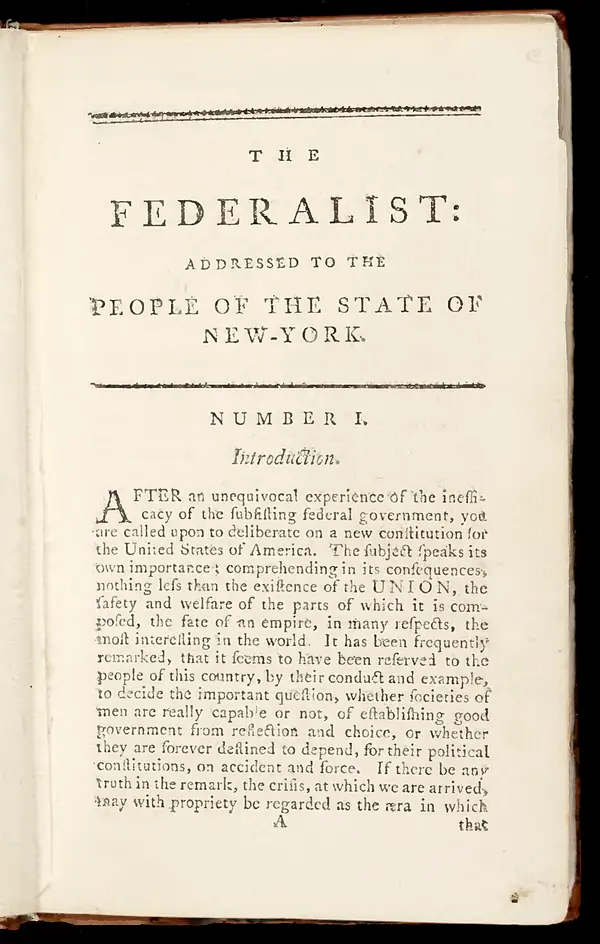
Hamilton opened Federalist No. 1 with the central claim of the entire series: that the ratification debate was not merely a political question but a test of whether deliberate self-government was possible at all.
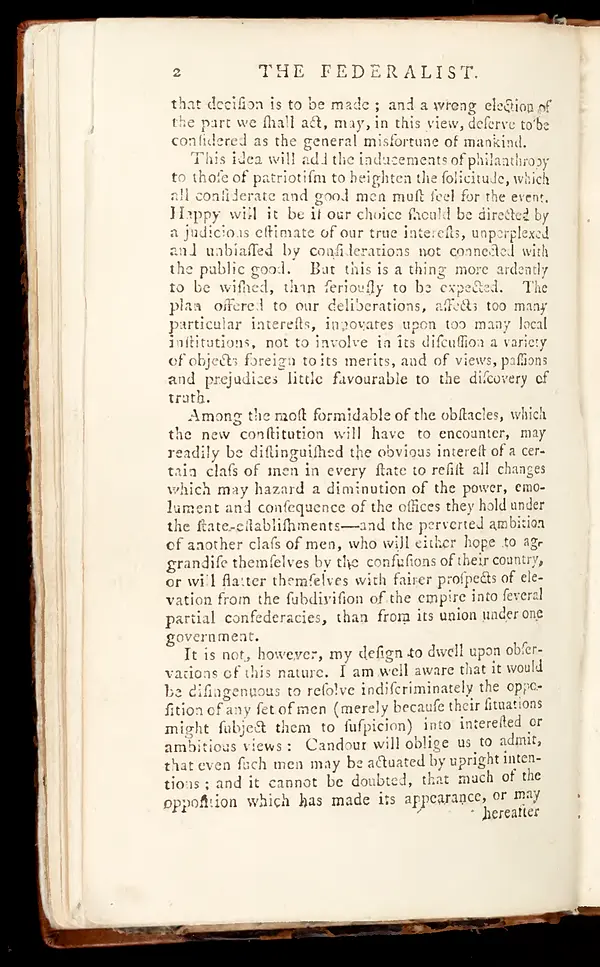
It has been frequently remarked that it seems to have been reserved to the people of this country, by their conduct and example, to decide the important question, whether societies of men are really capable or not of establishing good government from reflection and choice, or whether they are forever destined to depend for their political constitutions on accident and force.
This was not rhetorical framing. It was the substantive argument of the series. The United States was the first modern republic to attempt ratification of a written constitution by popular convention. Hamilton was saying the outcome of that process would constitute evidence about the capacity of self-government itself.
Hamilton also disclosed, in the same opening essay, that he had interests in the outcome: "I am clearly dissatisfied with it." He was referring to his own ambivalent view of the Constitution, which he believed too weak, but which he supported as better than the Articles of Confederation. The disclosure was not common in political writing of the period.
Federalist No. 1 outlined the subjects the series would address. Hamilton listed six: the utility of the union, the insufficiency of the Articles of Confederation, the necessity of an energetic government, the conformity of the Constitution to republican principles, its similarity to state constitutions, and the additional security it would provide for liberty and property.
He also named the category of opponent he expected to face: men whose "perverted ambition" caused them to oppose good government because they preferred the influence of a weak central authority, or men who had begun as genuine opponents but whose zeal had carried them past the facts. He did not name individuals. He named the type.
Among the most formidable of the obstacles which the new Constitution will have to encounter may be expected to come from a class of men who will either hope to aggrandize themselves by the confusions of their country, or who will flatter themselves with fairer prospects of elevation from the subdivision of the empire into several partial confederacies than from its union under one government.
Hamilton closed the essay by warning that he intended to pursue the argument without personal attacks and that he expected the same standard of criticism in return. The series that followed did not always meet that standard. The Anti-Federalist responses, published under names like Brutus and Federal Farmer, were detailed constitutional critiques. The exchange between Federalist and Anti-Federalist writing constitutes the most sustained public debate about constitutional government in American history.
The Federalist Papers are in the public domain. The original newspaper printings are held at the New-York Historical Society and the Library of Congress. The Hamilton Papers at the Library of Congress include manuscript drafts. Founders Online, operated by the National Archives, maintains a fully annotated digital edition. The Yale Avalon Project maintains the complete text series.
If you learned something new or just enjoyed the content, please share it and follow along on X and Substack. This page runs on a passion for our shared history, and a steady supply of caffeine. If you're able, consider buying a coffee. It goes a long way toward keeping the content coming.