1828
Forgotten Founders
The Founder Who Built an American Language

Noah Webster

He never signed the Declaration or the Constitution. He is in the founding record anyway, because he wrote the speller that taught generations of American children to read, delivered a pamphlet on government to Washington's own hands two and a half years before the Federalist Papers existed, shaped the Constitution's copyright clause to protect his own work, and spent twenty-one years building a dictionary because he believed a nation that could not preserve its own identity of ideas could not keep its own identity of language. He thought a country needed its own words. He spent his life proving it.

Born

October 16, 1758

Died

May 28, 1843

Dictionary Published

1828, 21 years' work

Primary Sources

6 confirmed

Noah Webster signed nothing. He held no office at the Constitutional Convention. He is in the founding record because of what he did with words -- the speller that taught a nation to read, the pamphlet that reached Washington before Hamilton had his idea, and the dictionary he believed a free people could not do without.

01
Hartford, Connecticut · 1758-1783
The Speller That Taught a Nation to Read

Noah Webster was born October 16, 1758, in Hartford, Connecticut, graduated Yale in 1778, and studied law under future Supreme Court Chief Justice Oliver Ellsworth. He never practiced law. He taught school instead, and what he found in the classroom troubled him: schoolbooks imported from England, teaching British spelling, British pronunciation, British political assumptions to children of a country that had just fought a war to stop being British.

In 1783, the year the Revolutionary War formally ended, Webster published The American Spelling Book -- soon nicknamed the "Blue-Backed Speller" for its cover. He deliberately altered British spelling conventions, dropping the "u" from words like "honour" and "favour," simplifying "centre" to "center." His stated purpose was direct.

"

[My purpose is] to diffuse uniformity and purity of language in America, [and] to destroy the provincial prejudices that originate in the trifling differences of dialect.

Noah Webster · Preface to The American Spelling Book · 1783 Internet Archive →

The book sold. By Webster's death in 1843, the various editions of his speller and grammar series had sold an estimated fifteen million copies; some estimates for total nineteenth-century circulation, including pirated editions from which Webster never saw a cent, run as high as one hundred million. For most of a century, the Blue-Backed Speller was how American children learned to read.

02
May 1785 · Washington's House · Internet Archive
The Pamphlet That Reached Washington First

In 1785, two and a half years before the Federalist Papers existed, Webster published a four-part pamphlet titled Sketches of American Policy. It argued that the Articles of Confederation were too weak to hold the country together and called for a stronger federal government with real authority over the states. Webster did not simply publish it and wait. In May 1785 he personally carried a copy to George Washington's house at Mount Vernon.

Source note -- the Hamilton dispute: Years later, Webster read a eulogy crediting Alexander Hamilton with first proposing the idea of radically restructuring the national government at the 1786 Annapolis Convention. Webster objected directly, in writing, noting that he had published Sketches of American Policy eighteen months earlier and had personally placed it in Washington's hands the previous summer. The dispute is a documented instance of a founder fighting, after the fact, for credit history had already assigned to someone else.

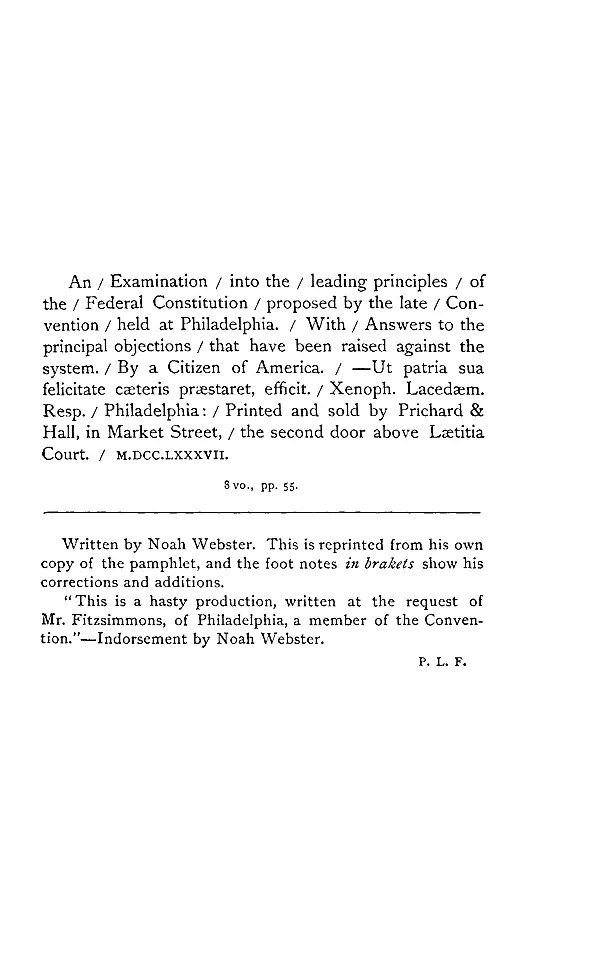
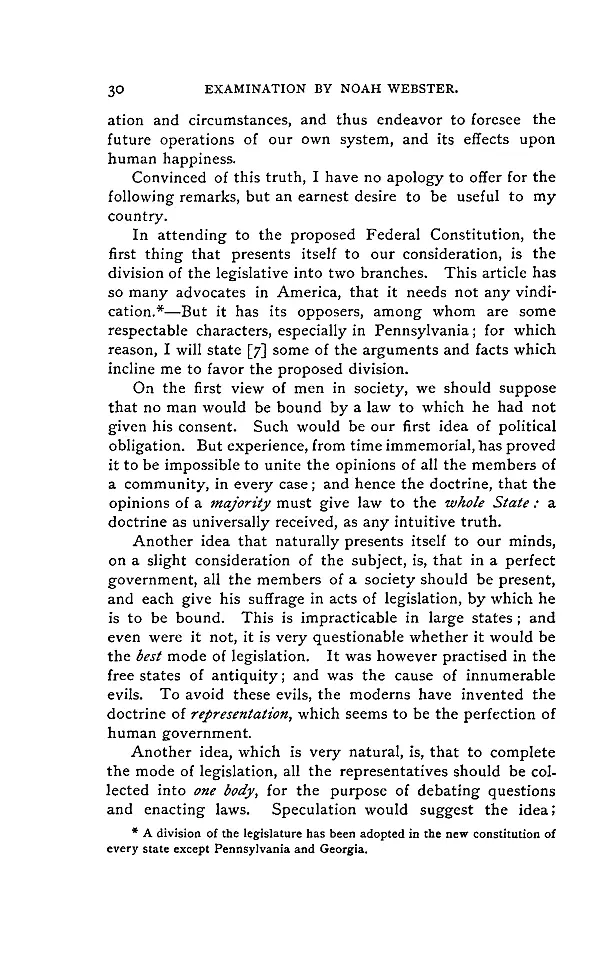
Webster also published a second major political work during the ratification fight: An Examination into the Leading Principles of the Federal Constitution, issued under the pseudonym "A Citizen of America" in October 1787, directly defending the proposed Constitution against its critics. A contemporary reader, the physician and historian David Ramsay, wrote to Webster that the pamphlet was already "in brisk circulation" and would be "of singular service in recommending the adoption of the new constitution."

03
1783-1790 · Article I, Section 8 · First Amendment Encyclopedia
The Clause He Helped Write to Protect His Own Book

Webster's speller was being pirated almost from the moment it was printed -- reprinted by other publishers who paid him nothing, in a country with no federal copyright law to stop them. Webster responded by personally touring state legislatures, lobbying each one in turn to pass its own copyright statute protecting authors' rights to their work. He is often credited as a primary influence behind the copyright clause that ended up in Article I, Section 8 of the Constitution, giving Congress the power "to promote the progress of science and useful arts, by securing for limited times to authors and inventors the exclusive right to their respective writings and discoveries." He later helped persuade Congress to pass the first federal copyright act in 1790. A founder's most personal financial grievance became a clause in the nation's founding document.

04
1807-1828 · Twenty-One Years · Internet Archive
Why He Spent Twenty-One Years on a Dictionary

Webster began serious work on a comprehensive American dictionary around 1807. He did not finish until 1828, when An American Dictionary of the English Language was finally published in two volumes, containing 70,000 entries, 12,000 of which had never appeared in any dictionary before. The twenty-one years cost him most of his adult fortune and put him permanently in debt. In his preface, Webster explained directly why the project mattered to him, and the explanation was not really about spelling at all. It was about national survival.

"

Language is the expression of ideas, and if the people of one country cannot preserve an identity of ideas, they cannot retain an identity of language. It is not only important but in a degree necessary that the people of this country should have an American Dictionary of the English Language; for although the body of the language is the same as in England, and it is desirable to perpetuate that sameness, yet some differences must exist.

Noah Webster · Preface to An American Dictionary of the English Language · 1828 Internet Archive →

Webster's reasoning was specific and political, not merely linguistic. He believed Britain and America had already become two different peoples with two different sets of ideas about government, liberty, and self-rule -- the Revolution itself was proof of that divergence. A people whose ideas had genuinely diverged from their parent country, he argued, could not keep speaking the parent country's language in exactly the parent country's way without that divergence eventually closing back up. The dictionary was not a reference book. It was an act of nation-building, performed one word at a time, intended to make permanent in language what the Revolution had won on the battlefield.

05
1820 · Founders Online
Madison Still Looking for the Pamphlet

In January 1820, thirty-five years after Sketches of American Policy was published and thirty-three years after the Constitution was ratified, James Madison wrote to Webster. Madison had lost his own copy of an earlier letter discussing the pamphlet's origin and asked Webster to help him reconstruct it -- and asked, almost in passing, where a copy of Sketches of American Policy could even still be found. The man who is remembered as the Constitution's principal architect was, decades later, still trying to track down the document that had helped persuade him a stronger union was necessary in the first place.

"

Where can the pamphlet "Sketches of American policy" be now obtained?

James Madison · To Noah Webster · January 18, 1820 · Founders Online Founders Online →
06
The Record
Why He Belongs in the Archive

Noah Webster signed no founding document and held no office at the Convention. He is in the founding record because the record is not only the names on the parchment. It includes the schoolbook that taught the parchment's readers to read, the pamphlet that reached a future president's hands before the Federalist Papers were written, the legal clause shaped by a struggling author's fight to be paid for his own work, and the dictionary built, word by word, on the conviction that a nation that could not keep its own language could not keep its own mind. He died May 28, 1843, in New Haven, Connecticut, in debt, having given most of two decades and most of his fortune to a book whose preface argued that a free people needed words of their own.

Go Deeper · Primary Sources
6 confirmed documents · All URLs live · All at institutional archives
← Series
All Forgotten Founders
A Note from the Founder

If you learned something new or just enjoyed the content, please share it and follow along on X and Substack. This page runs on a passion for our shared history, and a steady supply of caffeine. If you're able, consider buying a coffee. It goes a long way toward keeping the content coming, and helps the project grow into new mediums down the road. My sincere thanks.

- Jeff, FounderThe Founders' Record