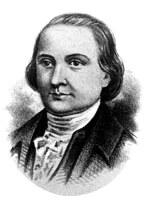
Three primary documents from the orphaned self-taught lawyer who signed for Georgia, was captured by the British at Savannah, spent nine months as a prisoner, and went on to hold every major office Georgia had to offer.
George Walton was born around 1741 in Frederick County, Virginia, the son of Robert Walton. He was orphaned young and was placed as an apprentice to a carpenter. He taught himself law by reading while working, and was admitted to the Georgia bar around 1774, having relocated to Savannah. His legal practice grew rapidly and he became involved in Georgia politics at the moment the colony was beginning to split between Loyalists and Patriots.
Walton was elected to the Continental Congress in 1776. He signed the Declaration of Independence alongside Button Gwinnett and Lyman Hall, Georgia's three signers, on August 2, 1776. He returned to Georgia and joined the military.
On December 29, 1778, British forces under Lieutenant Colonel Archibald Campbell attacked Savannah, Georgia. The city fell within hours. American forces under General Robert Howe were outnumbered and outmaneuvered. George Walton, serving as a Colonel of the First Georgia Regiment and commanding a militia unit, was wounded in the fighting and captured by British forces.
He was held prisoner for approximately nine months. During his captivity, the British offered to exchange him for a naval captain. The exchange was eventually completed in 1779. He was one of three signers of the Declaration of Independence to be captured during the war, alongside Richard Stockton (New Jersey) and the South Carolina trio at Charleston in 1780.
WALTON, George, a Delegate from Georgia; born about 1741, near Farmville, Prince Edward County, Va.; moved to Georgia and studied law; was admitted to the bar in 1774 and commenced practice in Savannah, Ga.; delegate to the Continental Congress, 1776-1778 and 1780-1781; signed the Declaration of Independence; served as Governor of Georgia in 1779 and 1789; Chief Justice of Georgia, 1783-1789; United States Senator from Georgia, 1795-1796; judge of the superior court until his death.
After his exchange in 1779, Walton resumed a public career of extraordinary breadth. He served as Governor of Georgia twice (1779, 1789). He served as Chief Justice of Georgia from 1783 to 1789. He was appointed to the United States Senate in 1795, serving until 1796. He was a judge on the Georgia superior court until his death.
Walton died on February 2, 1804, at approximately sixty-two, at his estate College Hill near Augusta, Georgia. He is buried in Augusta. Augusta's Walton Way and Walton County are named in his honor. He was the last of Georgia's three Declaration signers to die, outliving Gwinnett by twenty-seven years and Hall by fourteen.
If you learned something new or just enjoyed the content, please share it and follow along on X and Substack. This page runs on a passion for our shared history, and a steady supply of caffeine. If you're able, consider buying a coffee. It goes a long way toward keeping the content coming, and helps the project grow into new mediums down the road. My sincere thanks.