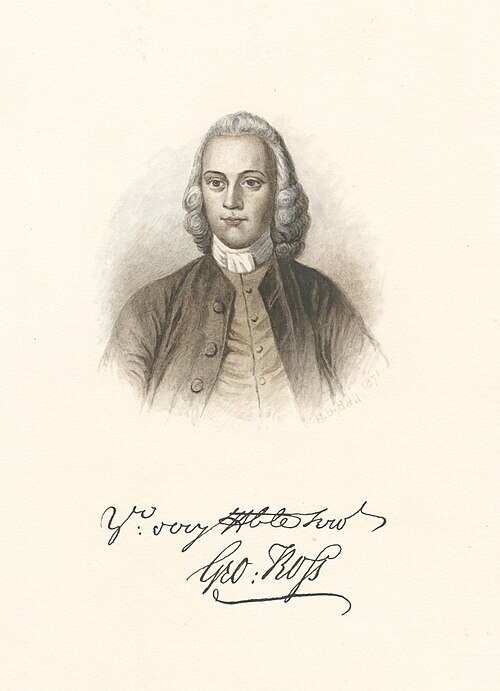
Four primary documents from the Crown Prosecutor who became a signer, an admiralty judge who defended states' rights, and died at forty-nine with a career still unfinished.
George Ross was born May 10, 1730 in New Castle, Delaware, the son of a Scottish-born Anglican clergyman. He read law in his older brother's office in Philadelphia and was admitted to the bar at twenty. He established his practice in Lancaster, Pennsylvania, where he built a successful career and served for twelve years as Crown Prosecutor, the attorney general for Carlisle County. His politics were initially Tory.
Elected to the Pennsylvania provincial legislature in 1768, Ross came to understand the colonial argument against Parliament firsthand. By 1775 he had shifted fully to the Patriot side, serving on the Pennsylvania Committee of Safety and accepting a colonel's commission in the Pennsylvania Associators. He was elected to the First Continental Congress in 1774 and returned for the Second.
Ross was not a member of the Pennsylvania delegation when the vote for independence was taken on July 2. He was elected to replace a delegate who did not support independence on July 20, 1776, sixteen days after July 4. He traveled immediately to Philadelphia and signed the engrossed parchment Declaration on August 2, 1776. He had arrived in time to add his name to a document whose purpose was already decided.
The same year, the Pennsylvania Legislature appointed Benjamin Franklin and George Ross president and vice-president, respectively, of a convention to draft Pennsylvania's first state constitution. The Journal of Congress for July 19, 1776, which ordered the engrossed parchment and the signatures, is at the Library of Congress.
Journal of Congress, July 19, 1776: Resolved, That the Declaration passed on the 4th, be fairly engrossed on parchment, with the title and stile of "The unanimous declaration of the thirteen United States of America," and that the same, when engrossed, be signed by every member of Congress.
Ross resigned from Congress in January 1777 due to recurrences of severe gout. In March 1779 he was appointed a judge of the Pennsylvania Court of Admiralty. In that capacity he presided over a case involving a dispute between a citizen of Connecticut and the State of Pennsylvania. When a congressional court of appeals overruled his decision, Ross refused to acknowledge the higher court's authority over state decisions, an early and significant early assertion of states' rights in the new republic that was not fully resolved until 1809.
A court order from Ross as admiralty judge in 1776, ordering the Philadelphia marshall to summon a jury to try a case involving the privateer Enterprise, is at the LOC House Archives. Ross died on July 14, 1779, at forty-nine, having been in the admiralty judgeship only three months. He is buried at Christ Church Burial Ground in Philadelphia, alongside Benjamin Franklin, Benjamin Rush, Joseph Hewes, and Francis Hopkinson.
Court order from George Ross, as judge of the Admiralty Court of Pennsylvania · 1776 · ordering Philadelphia marshall Matthew Clarkson to summon a jury to the Court of Admiralty to try a case involving James Campbell of the privateer "Enterprise" and George Corrie of the "Black River." · LOC House Archives
If you learned something new or just enjoyed the content, please share it and follow along on X and Substack. This page runs on a passion for our shared history, and a steady supply of caffeine. If you're able, consider buying a coffee. It goes a long way toward keeping the content coming, and helps the project grow into new mediums down the road. My sincere thanks.