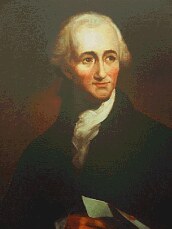
Five primary documents from the man who disagreed, then committed more fully than almost anyone. The vote against. The resolution against traitors. The acting governorship. The Constitution. The three foundational documents.
George Read was born in Cecil County, Maryland in 1733 and moved to Delaware as a child. He was admitted to the bar at nineteen and built a reputation as one of the most capable lawyers in the region. He was appointed Attorney General for Delaware's three counties in 1763, served in the First Continental Congress in 1774, and entered the Second Continental Congress in 1775.
Read opposed independence, not from loyalty to the Crown, but from the belief that the timing was wrong. He had opposed the Stamp Act and was firmly in the Patriot cause. He simply thought a formal declaration premature. On July 2, 1776, George Read was the only delegate who voted against independence and then signed the Declaration of Independence.
On July 2, 1776, the Continental Congress voted on Richard Henry Lee's resolution for independence. Nine colonies voted in favor. Read voted against, the only Delaware delegate to do so. The vote is recorded in the Journals of the Continental Congress at the Library of Congress: memory.loc.gov/ammem/amlaw/lwjclink.html. Once the resolution passed, Read signed the Declaration of Independence on August 2, 1776.
After signing the Declaration, Read introduced a resolution to Congress stating that anyone who willfully broke the agreement set forth in the Declaration should have their name published in the newspapers as a betrayer of civil rights and forever be deemed infamous. The man who had voted against independence was now proposing the harshest consequences for those who abandoned it.
In 1776 Read also presided over the Delaware state constitutional convention and authored Delaware's first state constitution. When the British captured Delaware's Governor John McKinly in October 1777, Read stepped in as acting President of Delaware and guided the state through the most dangerous phase of the war.
that anyone who shall willfully break this agreement shall have his name published in the Public Newspaper as a betrayer of the civil rights of America and forever be deemed infamous and a traitor.
Read served as acting President of Delaware from October 1777 through March 1778, stabilizing the state under British pressure. He then returned to Delaware politics, serving in the state legislature and as a judge. At the Constitutional Convention in 1787, he was among the most active Delaware delegates, supporting a strong central government and equal representation for small states in the Senate.
Read is one of only two men to have signed all three foundational documents: the Petition to the King (First Continental Congress, 1774), the Declaration of Independence, and the Constitution. He signed as a representative of Delaware, a state he served as Attorney General, acting Governor, U.S. Senator, and Chief Justice across five decades of public life.
Read was elected one of Delaware's first United States Senators (1789–1793), then appointed Chief Justice of Delaware, a position he held until his death in 1798. He is one of the least-known founders with one of the most consequential records, three foundational documents, acting Governor under enemy occupation, author of Delaware's first constitution, and a U.S. Senator in the first Congress.
His papers are at the Delaware Historical Society in Wilmington. Selected correspondence is at Founders Online.
If you learned something new or just enjoyed the content, please share it and follow along on X and Substack. This page runs on a passion for our shared history, and a steady supply of caffeine. If you're able, consider buying a coffee. It goes a long way toward keeping the content coming, and helps the project grow into new mediums down the road. My sincere thanks.