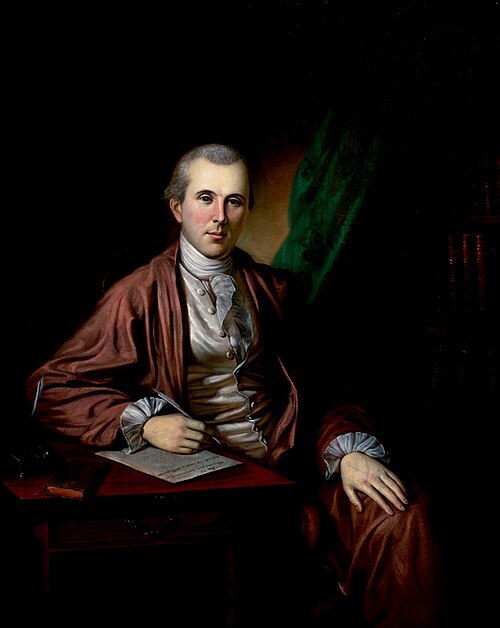
Six primary documents from the doctor who signed, fought, stayed during the epidemic, and spent his final years bringing two ex-presidents back together. The record is at Founders Online and the American Philosophical Society.
Benjamin Rush was born in 1745 near Philadelphia, graduated from the College of New Jersey (Princeton) in 1760 at age fourteen, and trained in medicine in Edinburgh, the finest medical school in the English-speaking world. He returned to Philadelphia in 1769 as one of the most educated physicians in America. He was thirty years old when he signed the Declaration of Independence. He was the only physician among the fifty-six signers.
He was already known as an abolitionist. His 1773 pamphlet, An Address to the Inhabitants of the British Settlements in America upon Slave-Keeping, was one of the earliest published anti-slavery arguments by an American. His mentor was Benjamin Franklin, to whom he had been introduced in London.
I have conversed and corresponded much with Dr. Franklin on the subject of Slavery. He is an avowed enemy to it, and I believe will never cease to oppose it while he has the use of his pen and his influence.
Rush enlisted as a surgeon general in the Continental Army and was with Washington's forces in the days before and after the crossing of the Delaware on Christmas night, 1776. He treated casualties at Trenton and Princeton. He wrote to Richard Henry Lee about the conditions in the field hospitals and about the desperate state of the army. Those letters are in the American Philosophical Society collection and are referenced in the published Letters of Benjamin Rush.
Rush later fell out with Washington over what he believed was incompetent management of the medical corps, writing an anonymous letter to Patrick Henry criticizing the commander in chief. The letter was eventually traced back to Rush. He resigned his commission in 1778.
In 1793, yellow fever devastated Philadelphia, killing an estimated 5,000 people, roughly one in ten residents. Rush stayed in the city and treated patients through the epidemic while most of the government and many physicians fled. His treatment, aggressive bloodletting and purging, was later criticized as harmful, but his decision to remain when others fled was not questioned. He contracted yellow fever himself and nearly died.
He wrote about the epidemic in detail in An Account of the Bilious Remitting Yellow Fever, as It Appeared in the City of Philadelphia, in the Year 1793, published the following year. The account is a primary document of the epidemic. The Library Company of Philadelphia holds original copies.
John Adams and Thomas Jefferson had not communicated in more than a decade after the election of 1800 ended their friendship. Rush spent years working to reconcile them. In February 1809 he wrote to Adams describing a dream in which the two men had been brought together. Adams replied: "A Dream again! I wish you would dream all day and all Night, for one of your Dreams puts me in spirits for a Month."
A Dream again! I wish you would dream all day and all Night, for one of your Dreams puts me in spirits for a Month. I have no other objection to your Dream, but that it is not History. It may be Prophecy.
Rush continued the campaign. In 1811 he told Jefferson that Adams had said he still loved him. Jefferson was moved. Adams wrote first. The correspondence between Adams and Jefferson that followed, 158 letters over the final fourteen years of their lives, was initiated by Rush. Both men died on July 4, 1826. Rush died in 1813 and did not live to see it completed. Adams wrote afterward that Rush had done more good in the world than Franklin or Washington.
Rush was present at the signing of the Declaration of Independence on August 2, 1776. In 1811 he wrote to John Adams describing the scene in the State House that morning, one of the most vivid primary accounts of what it felt like to sign the document. The letter also contains the Benjamin Harrison gallows joke, the only contemporary record of that exchange.
Do you recollect the pensive and awful silence which pervaded the house when we were called up, one after another, to the table of the President of Congress, to subscribe what was believed by many at that time to be our own death warrants? The Silence & the gloom of the morning were interrupted I well recollect only for a moment by Col: Harrison of Virginia who said to Mr Gerry at the table, "I shall have a great advantage over you Mr: Gerry when we are all hung for what we are now doing. From the size and weight of my body I shall die in a few minutes, but from the lightness of your body you will dance in the air an hour or two before you are dead."
If you learned something new or just enjoyed the content, please share it and follow along on X and Substack. This page runs on a passion for our shared history, and a steady supply of caffeine. If you're able, consider buying a coffee. It goes a long way toward keeping the content coming, and helps the project grow into new mediums down the road. My sincere thanks.