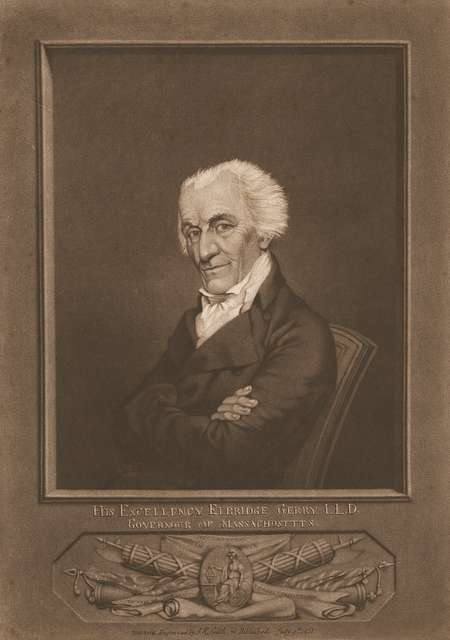
Three documents define Elbridge Gerry's record: the Declaration he signed, the Constitution he refused, and the letter he sent to the Massachusetts legislature explaining why. All three are in the archive. The episode presents them in order.
Elbridge Gerry of Marblehead, Massachusetts graduated from Harvard in 1762 and entered his family's merchant trade. He was elected to the Massachusetts Provincial Congress in 1774, served on the Committee of Correspondence, and was a delegate to the Second Continental Congress from 1776 to 1780. He signed the Declaration of Independence on August 2, 1776. He signed the Articles of Confederation in 1778. He was an early advocate of independence and an active delegate.
He returned to the Continental Congress again from 1783 to 1785 under the Articles of Confederation. His service record is at the Biographical Directory of Congress at history.house.gov. His Congressional service is documented in the Journals of the Continental Congress at the Library of Congress.
Gerry came to the Constitutional Convention in Philadelphia in May 1787. He spoke the sixth most times of any delegate over the course of the summer, more than any other delegate except Madison. By September he had concluded the proposed Constitution threatened the liberties of the people and the rights of the states. On September 12, 1787, five days before the Convention ended, he and George Mason moved that the Constitution be prefaced with a bill of rights.
Madison's Notes on the Constitutional Convention, held at the Library of Congress, record what happened next. The motion was put to a vote. Every state delegation voted against it. The motion failed unanimously. The Library of Congress exhibition "Creating the United States" documents Madison's notes of the September 12 session.
Mr. Gerry moved for a Committee to prepare a Bill of Rights. Col. Mason seconded & obs[erved] that it would give great quiet to the people; and with the aid of the State declarations, a bill might be prepared in a few hours. Mr. Sherman was for securing the rights of the people where requisite. The State Declarations of Rights are not repealed by this Constitution; and being in force are sufficient. The motion was rejected by all the States.
On September 15, Gerry again spoke against the Constitution. On September 17, when thirty-nine delegates signed, Gerry, along with George Mason and Edmund Randolph, declined. The Constitution went to the states for ratification without a bill of rights.
On October 18, 1787, Gerry sent the Massachusetts General Court a letter explaining his refusal to sign. The letter was read in the Massachusetts Senate on October 31 and in the House of Representatives on November 2. It was published in the Massachusetts Centinel on November 3, 1787, under the headline "Hon. Mr. Gerry's Objections to Signing the National Constitution." The letter is held in the National Archives in the Records of the Continental and Confederation Congresses and the Constitutional Convention, Record Group 360.
It was painful for me, on a subject of such national importance, to differ from the respectable members who signed the constitution: But conceiving as I did, that the liberties of America were not secured by the system, it was my duty to oppose it. My principal objections to the plan are, that there is no adequate provision for a representation of the people, that they have no security for the right of election, that some of the powers of the legislature are ambiguous, and others indefinite and dangerous, that the executive is blended with, and will have an undue influence over, the legislature, that the judicial department will be oppressive, that treaties of the highest importance may be formed by the president with the advice of two-thirds of a quorum of the senate, and that the system is without the security of a bill of rights.
When the Constitution was ratified, Gerry gave it his support. He was elected to the First and Second Congresses (1789–1793). He voted for the Bill of Rights he had demanded. He served on a diplomatic mission to France in 1797, the XYZ Affair, documented at Yale Avalon and Founders Online. He served as Governor of Massachusetts from 1810 to 1811. In 1812 he was elected Vice President of the United States on the ticket with James Madison, the same James Madison who had watched him refuse to sign the Constitution twenty-five years earlier.
Gerry died in office as Vice President on November 23, 1814. He is the only founding father buried in Washington, D.C. at the Congressional Cemetery.
In 1812, while Gerry was Governor of Massachusetts, the Massachusetts legislature redrew state senate districts in a way that concentrated Federalist voters into as few districts as possible. The resulting map produced one district shaped, with some imaginative assistance, like a salamander. The Boston Gazette published a cartoon of the district on March 26, 1812, combining the Governor's name with the shape of the beast: "Gerry-mander." The word entered the political vocabulary permanently.
Gerry did not draw the district himself. He signed the redistricting bill into law. The Library of Congress holds the original Boston Gazette cartoon. The gerrymander map and the cartoon are primary documents at the LOC American Memory collection.
If you learned something new or just enjoyed the content, please share it and follow along on X and Substack. This page runs on a passion for our shared history, and a steady supply of caffeine. If you're able, consider buying a coffee. It goes a long way toward keeping the content coming, and helps the project grow into new mediums down the road. My sincere thanks.